
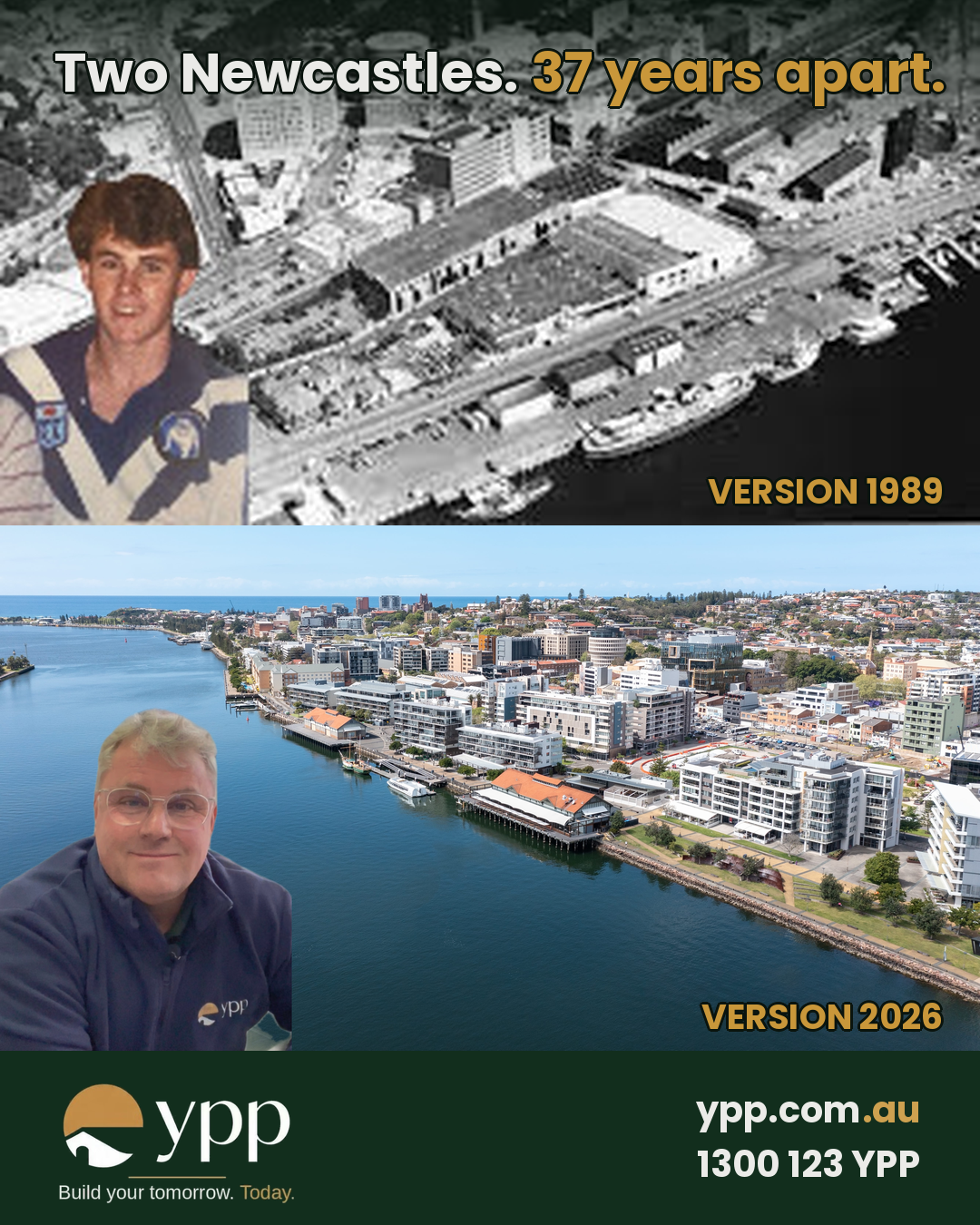
Picture a 17-year-old first-year university student arriving in Newcastle at the beginning of 1989.
The city that greeted him was a steel town, plain and simple. The BHP steelworks dominated the harbour and the skyline, and it dominated life too. Thousands of workers streamed through its gates every shift, and half the city seemed to be employed by it, supply it, or serve the people who did. The air near Mayfield had a flavour. Coal trains rumbled through around the clock. Newcastle wasn’t trying to be pretty. It was too busy being productive.
The uni was at Callaghan, in bushland, a world away from the working harbour. The city’s beaches were magnificent even then, and that part hasn’t changed, but the harbourside was industrial land, rail yards and wharves. Not a place you’d go for a flat white. Also because flat whites hadn’t been invented yet!
And then, just before the end of that student’s first year, the ground literally shook. The December 1989 earthquake devastated parts of the city and took thirteen lives. It remains one of Australia’s most serious natural disasters, and for Novocastrians it marked the end of an era in more ways than one. This uni student, the person writing this article, was standing in the Macca’s in Mayfield as the floor was pulled from under him.
“This city will die.”
A decade later came the news everyone had feared for years: BHP would close the steelworks. In 1999, after seven decades, steelmaking in Newcastle ended.
The predictions were bleak. A one-industry town losing its industry. Surely the city would hollow out, the young people would leave, and property would be worth next to nothing.
Almost exactly the opposite happened.
The reinvention.
Newcastle didn’t die. It diversified. And then it thrived.
The university came to town. No longer tucked away at Callaghan, the University of Newcastle built a city campus and pulled thousands of students and staff into the heart of the CBD.
Health and education replaced steel as the region’s biggest employers, joined by defence, engineering, energy, and a growing tech and startup scene.
The harbourfront transformed. The industrial land along the water became Honeysuckle. Apartments, restaurants, offices, and promenades where the rail yards used to be. The heavy rail line into the city was cut back, light rail arrived, and the East End filled with the kind of bars and eateries that 1989 Newcastle couldn’t have imagined.
The lifestyle got discovered. Working beaches-and-harbour cities are rare. Once Sydneysiders realised they could swap a two-hour commute and a seven-figure mortgage for ocean baths, surf breaks, and a genuine city, and once remote work made it practical, the migration north was on.
Our 1989 student paid next to nothing to live in a draughty share house near the uni. The suburbs they lived and studied in have since seen property values multiply many times over. The kind of long-run growth that turns “cheap student digs” into “I should have bought that street.”
The towns that “seemed so far away.”
Here’s the part investors should pay closest attention to.
In 1989, Maitland and Cessnock felt like separate worlds. Maitland was the old river town you passed through on the New England Highway. Cessnock was the coalfields. A hard-working town on the way to some vineyards that only wine buffs talked about. Going to either town from Newcastle felt like a proper day trip. They were “out there.”
They aren’t “out there” anymore.
The Hunter Expressway, opened in 2014, and instantly rewired the region’s geography. Suddenly Cessnock and the vineyards were a smooth half-hour from Newcastle, and Maitland was stitched tightly into the metropolitan fabric. Distance that used to be measured in “why would you?” is now measured in minutes.
The results speak for themselves:
Maitland has become one of the fastest-growing areas in regional NSW, with entire new suburbs rising on its fringes. Young families chasing space, new housing, and a commute that works.
Cessnock rides two booms at once. It’s the gateway to the Hunter Valley’s wine tourism economy, now a genuine international drawcard, as well as a landing spot for growth spilling out of Newcastle and Maitland, with major new communities emerging nearby.
The region between them is filling in, turning what used to be a string of separate towns into one connected growth corridor. That first-year student in 1989 would have laughed at the idea of Maitland and Cessnock being property hotspots. Nobody’s laughing now.
The lesson for today’s investor.
The Newcastle and Hunter story isn’t just nostalgia. It’s a masterclass in how regions transform, and the signals that are repeatable.
1. Economic diversification. When a region moves from one industry to many, it becomes more resilient and more valuable.
2. Infrastructure shrinks distance. One expressway turned “far away” towns into a commuter belt. Roads, rail, and airports redraw the property map every time.
3. Universities and hospitals anchor growth. Institutions bring stable jobs, students, and services that don’t leave when commodity prices dip.
4. Lifestyle is the accelerant. When a place becomes somewhere people “want” to live, not just work, demand compounds.
Every one of those signals was visible in the Hunter years before prices reflected them. And right now, in emerging regions across Australia, the same signals are flashing again.
The takeaway.
The Newcastle of 1989, steel, smoke, and share houses, became one of Australia’s great regional success stories. The towns that seemed too far away became the growth corridor.
The question for investors isn’t “how did we miss it?”. It should be “where is this happening next?”. And finding those places before the crowd does is exactly what we at YPP spend our days doing.